

Why Gaming Brands Need to Rethink SEO in 2026 and Beyond
Welcome to The New Game of Search, a six-part series on how gaming brands can stay visible in a changing search landscape.
For decades, SEO was a game of rankings — keyword research, building links and optimizing for the latest algorithm update. But 2025 unlocked a new mode, one where search behaves less like a static leaderboard and more like a living ecosystem shaped by AI, context, and user intent.
For gaming brands, visibility now means more than appearing on page one — it’s about being accurately represented across generative search, AI Overviews, and LLM-powered discovery engines.
Because if your content isn’t visible to AI crawlers, it’s invisible to the next generation of players.
So how does the gaming industry adapt? And what can your brand do right now to stay visible in the new era of search?
As part of our series, this blog post introduces the core fundamentals of AI SEO — Generative Engine Optimization (GEO), Answer Engine Optimization (AEO), and LLM Visibility — that will define how players find and engage with gaming content in the years ahead.
Level One: The Old Rules of SEO No Longer Work

Traditional SEO played by strict rules — optimize, rank, repeat. It was a system built for algorithms, not for people and the evolving ways users actually discover content. And while traditional SEO is still important for a healthy Search Engine Results Pages (SERP) presence, that alone is not enough.
Both users and algorithms have evolved. Players now discover games through TikTok trends, Twitch streams, Discord communities, and increasingly, AI-powered summaries of what’s new and worth playing.
Search engines now care less about keywords and more about entities, context, and authority. That means the way gaming brands structure, describe, and connect their stories must evolve, too.
How We Got Here: A Quick Timeline of SEO Evolution
- 1990s – The Dawn of Search
Search engines like Yahoo! and AltaVista relied almost entirely on keyword matching and meta tags. Ranking was as simple as stuffing a page full of repeated phrases. - Early 2000s – The Google Era Begins
Google’s PageRank shifted focus toward backlinks and link authority, marking the start of technical and off-page SEO as core disciplines. - 2010–2015 – The Rise of Quality & Intent
Updates like Panda, Penguin, and Hummingbird began penalizing keyword stuffing and rewarded content relevance, site speed, and user experience. - 2016–2020 – The Age of Mobile & Semantics
Voice search, schema markup, and mobile-first indexing changed how content was structured and understood. Search moved from strings (keywords) to things (entities). - 2021–Present – The AI & Experience Era
AI-driven search (Google’s MUM, Gemini, Microsoft Copilot) and generative answers began redefining visibility. Authority, originality, and contextual relevance now outweigh traditional ranking factors.
To stay visible, gaming brands need a new skill tree — GEO, AEO, and LLM Visibility are the next-level tactics that bridge human storytelling with machine understanding — helping context show up not just on search results, but inside the AI conversations shaping what players explore next.
Level Two: Enter AI-Driven Search
Generative AI has changed how people search, interpret, and trust information. Users no longer just “Google” what they’re curious about — they ask questions, seek summaries, and expect instant, personalized answers.
When players ask an AI tool, “What are the best upcoming RPGs for PC?” that response may pull from dozens of sources — gaming blogs, review sites, community threads, and press materials — all synthesized by a Large Language Model (LLM). The better your content communicates expertise and authoritativeness, the more likely it is to be included in those AI-generated answers.
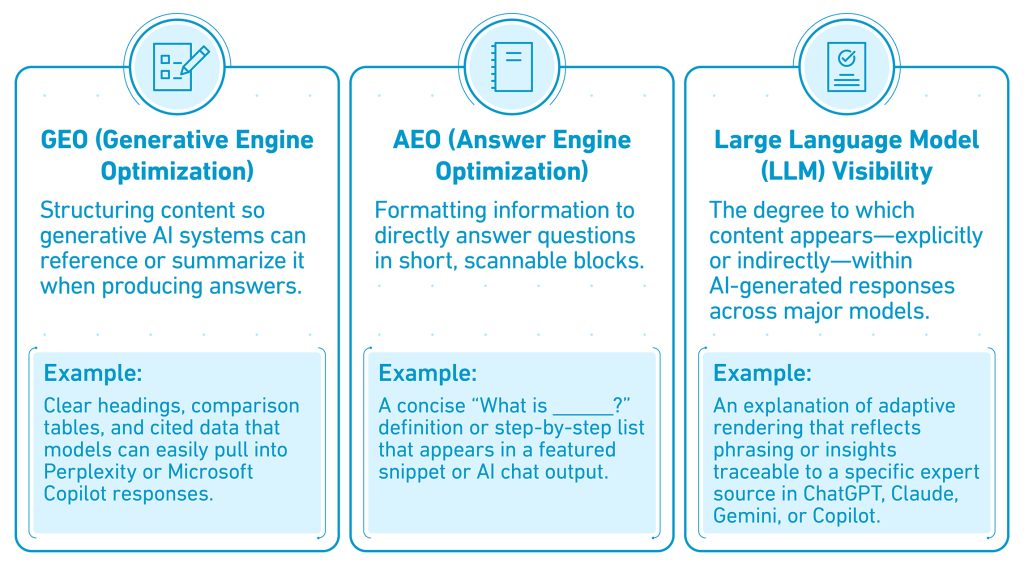
That’s where GEO, AEO, and LLM Visibility come in:
GEO (Generative Engine Optimization)
- Structuring content so generative AI systems can reference or summarize it when producing answers.
Example: Clear headings, comparison tables, and cited data that models can easily pull into Perplexity or Microsoft Copilot responses.
AEO (Answer Engine Optimization)
- Formatting information to directly answer questions in short, scannable blocks.
Example: A concise “What is ____?” definition or step-by-step list that appears in a featured snippet or AI chat output.
Large Language Model (LLM) Visibility
- The degree to which content appears — explicitly or indirectly — within AI-generated responses across major models.
Example: An explanation of adaptive rendering that reflects phrasing or insights traceable to a specific expert source in ChatGPT, Claude, Gemini, or Copilot.
These aren’t just acronyms—they’re the new battlegrounds for search visibility.
For gaming brands, mastering these layers means building content that’s not only searchable, but also summarizable, shareable, and semantically understood by AI. It’s the difference between being mentioned passively in someone else’s summary, and being the trusted source that powers it.
Level Three: Why Gaming Brands Are Falling Behind
Gaming marketing has always thrived on storytelling and world-building, and creating experiences that pull players in long before they pick up a controller. But in a search ecosystem powered by AI, storytelling alone isn’t enough. The best campaigns now need the same strategic structure that drives discoverability and authority online.
Too often, brands still treat SEO as a finishing touch instead of a foundation. Their most powerful stories — developer insights, campaign pages, and innovation articles — are often unstructured or disconnected, leaving AI systems unable to interpret or cite them accurately.
The result? Great content that never makes it to the generative conversation.
The new search landscape rewards stories that make sense to both humans and machines. Gaming brands that combine creative storytelling with intentional structure — clear context, consistent messaging, and connected topic relationships — help AI understand and elevate their narratives.
When done right, your content doesn’t just rank; it appears, influences, and drives discovery across multiple AI surfaces.
Level Four: What Modern SEO Looks Like in 2026
From Search Terms to Storytelling Systems
Modern SEO isn’t about keeping up with algorithms — it’s about being recognized for what your brand does best. In 2026, visibility depends on how clearly and consistently you tell your story across every discovery surface, from Google and Gemini to the social spaces and communities where players explore what’s next. The brands leading this shift communicate with purpose, building trust through clarity, credibility, and connection.
The Building Blocks of Modern Visibility
Modern SEO works a lot like good game design — it rewards clear logic, connected worlds, and meaningful interaction. The brands getting noticed aren’t louder; they’re easier to understand.
- Entity clarity: Show how your people, products, and stories connect. The clearer the map, the easier AI can navigate it.
- Smart structure: Metadata and schema aren’t technical chores — they’re the architecture that helps your story travel.
- Everywhere discovery: Build for visibility across Google, Gemini, YouTube, TikTok, and the player communities driving real conversations.
- Proven credibility: Let expertise and originality be your proof points; algorithms (and players) notice the difference.
Modern visibility isn’t about volume — it’s about coherence. When everything you publish connects back to a shared story and purpose, discovery feels natural, not forced, and your content starts to work together — press releases support campaigns, innovation stories reinforce brand values, and search engines start recognizing the pattern.
That’s what modern SEO really is: not a checklist, but a living system that teaches both users and algorithms who you are and why you matter.
Final Boss: Future-Proofing Your Gaming SEO Strategy 2026
If your SEO approach still feels stuck a few versions behind, it’s time to upgrade. The gaming brands leading in 2026 and beyond aren’t reacting to change — they’re anticipating it, building search ecosystems designed to grow smarter over time.
Modern SEO isn’t just about now. It’s about how you stay discoverable throughout 2026 and every update that follows.
Ready to level up? Stick with us as we roll out the full SEO series — and get connected with Off Base to stay ahead of what’s coming next.


Let’s Co-Op on Something Epic
We’re all about creative combos and game-changing strategies. Drop us a line, and let’s craft your next victory together.