

From Keywords to Entities: The New Rules of SEO for the Gaming Industry
In Part One of this series, we explored how SEO for gaming brands is no longer just about rankings — it’s about discoverability across a growing ecosystem of AI-powered search experiences.
In Part Two, we’re digging deeper into the structural shift powering that change: the move from keyword-based optimization to entity-based SEO. As search engines evolve to understand meaning, relationships, and context — not just strings of text — gaming companies need to rethink how their content is organized, connected, and interpreted by both humans and machines. This post breaks down what entity-based SEO actually means, why it matters for the gaming industry, and how brands can start adapting their strategies for 2026 and beyond.
From Keywords to Worlds: What Entity-Based SEO Really Means
Traditional SEO-trained marketers tend to think in keywords: pick a term, optimize a page, and hope it ranks. Entity-based SEO shifts the focus from isolated phrases to things — real, definable concepts like games, studios, franchises, genres, platforms, characters, technologies, and communities. Search engines now work to understand how these entities relate to one another, not just how often a phrase appears on a page.
For gaming brands, this mirrors how players already think. A single game doesn’t exist in a vacuum — it connects to a studio, an engine, a genre, a platform, a release era, and a broader cultural conversation. Entity-based SEO enables search engines to interpret those relationships, making it easier for your content to surface when users (or AI systems) explore topics holistically rather than searching for a single exact phrase.
Instead of asking “How do we rank for this keyword?” the better question becomes: “Have we clearly defined who we are, what we make, and how it all connects?”
Entities vs. Keywords: Why Semantic Search Changes Everything
This shift is driven by semantic search, where engines analyze intent, context, and meaning rather than matching words verbatim. Platforms like Google — and increasingly Google Gemini — use entity understanding to answer complex questions, generate summaries, and surface content on generative Search Engine Results Pages (SERP).
So, someone researching a game genre might not search for a specific studio name at all. Instead, they explore themes, mechanics, or cultural impact. Search engines rely on entity relationships to determine which brands, franchises, or creators are authoritative within that space.
This is where many gaming sites struggle. Content may be well-written, but it’s fragmented — pages exist as standalone pieces instead of connected parts of a larger topic ecosystem. Without clear signals tying content together, search engines can’t easily determine topic authority.
Entity-based SEO helps solve this by reinforcing meaning through internal links, consistent terminology, and contextual storytelling that reflects how topics naturally overlap in the gaming world.
How Search Engines See Relationships (Not Just Pages)
At the heart of entity-based SEO is relationship mapping. Search engines build internal knowledge graphs that connect people, places, products, media, and concepts based on how often and how clearly those relationships are established across the web.
For gaming and entertainment brands, this might include connections between:
- A franchise and its individual titles
- A studio and its development philosophy
- A game and its platform ecosystem
- A genre and its defining mechanics
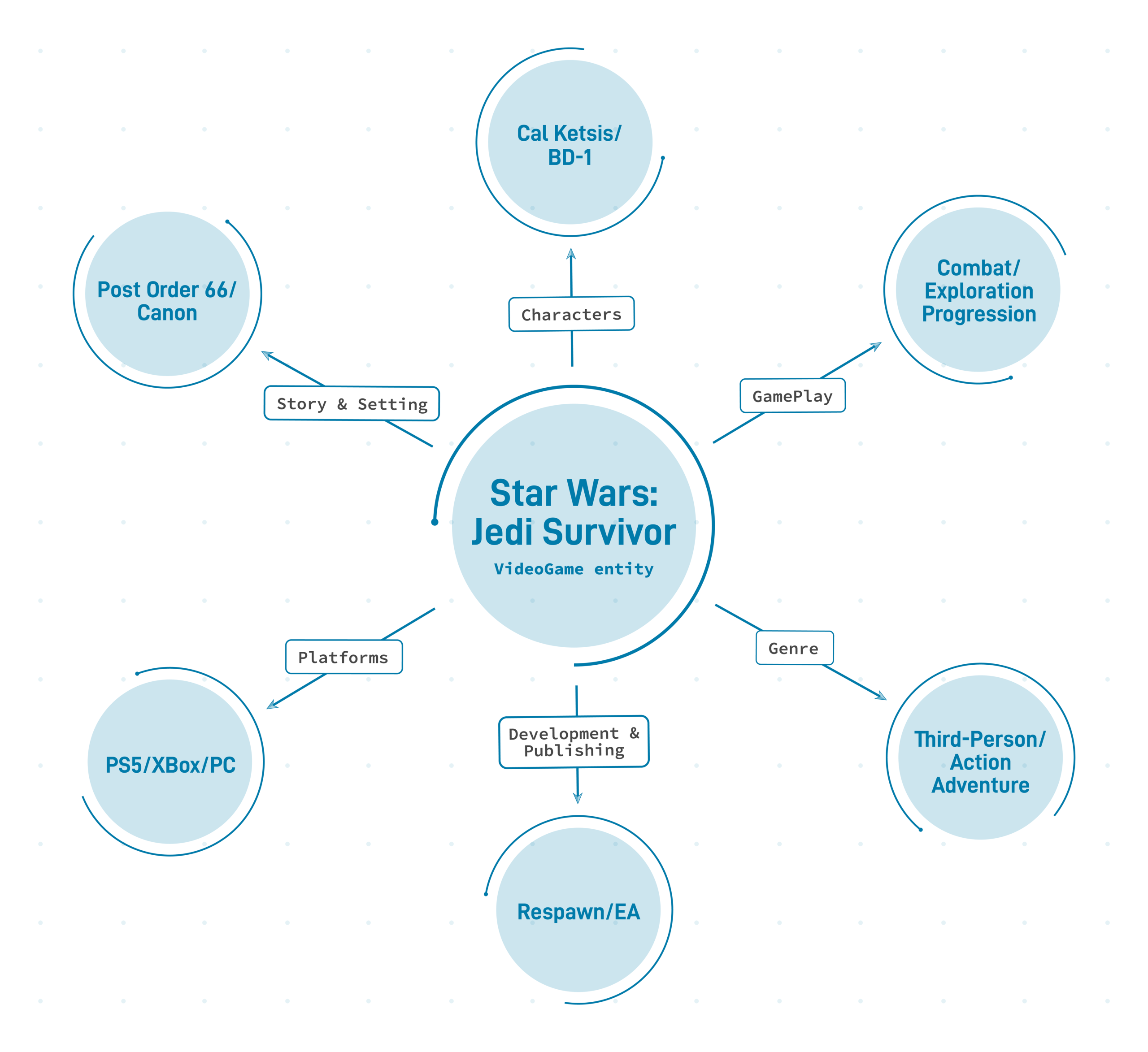
The more consistently your content reinforces these connections, the easier it becomes for search engines — and AI models — to interpret your brand as an authority within its space.
Structured Data: Teaching Machines How Your World Fits Together
How do gaming and entertainment brands signal to search engines and AI the relationships between entities?
While strong content establishes meaning for human readers, structured data does the same for machines. Using schema.org vocabulary implemented via JSON-LD, brands can explicitly define what each page represents and how it relates to other entities.
Structured data doesn’t replace content — it clarifies it. For gaming companies, this might mean marking up:
- Games as SoftwareApplication or VideoGame entities
- Studios as Organizations
- Reviews, ratings, platforms, and release data
- Related franchises, expansions, or sequels
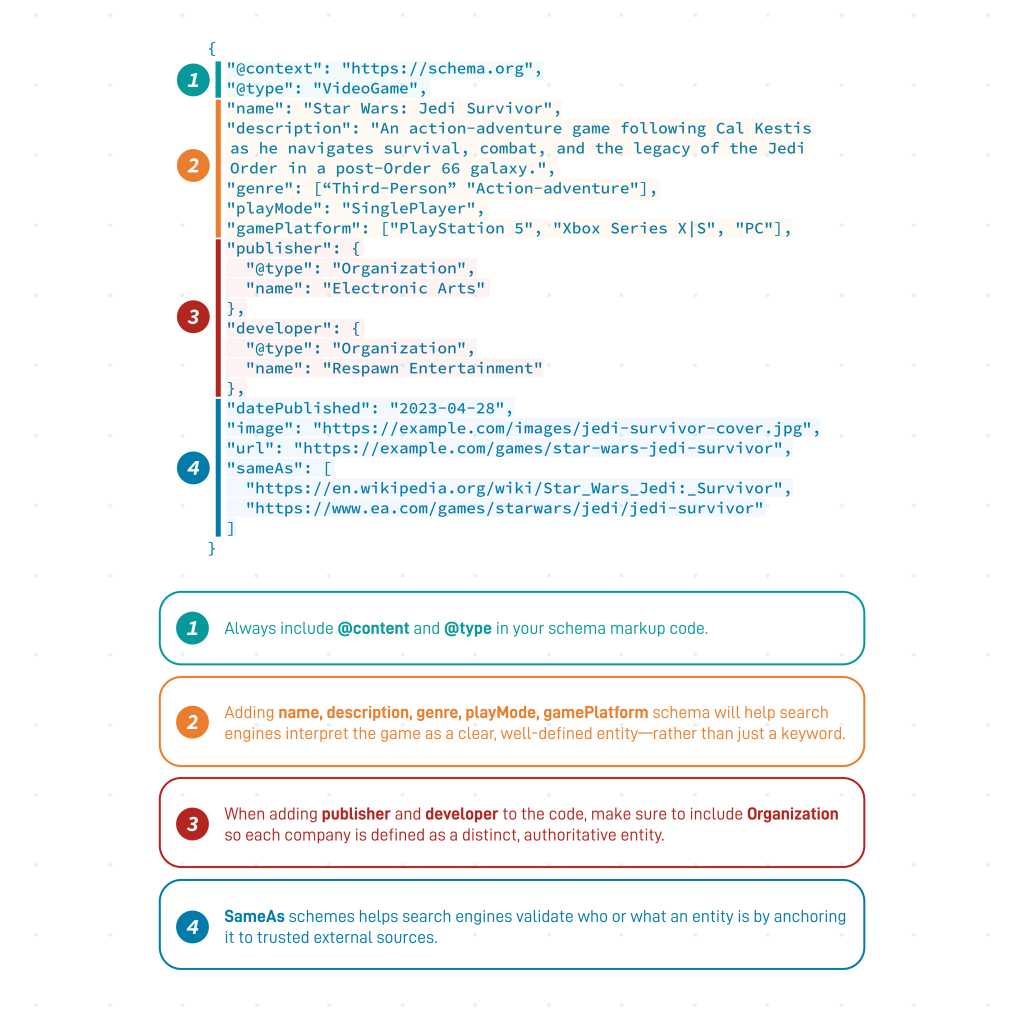
This clarity becomes especially important for AI search visibility, where large language models (LLMs) rely on trusted, structured signals to generate accurate summaries, recommendations, and citations.
Content Clustering: Building Topic Authority in Gaming SEO
Entity-based SEO works best when supported by content clustering — grouping related content around a central topic rather than scattering pages across a site with no clear hierarchy. For gaming brands, clusters might form around genres, innovation themes, player experiences, or industry trends.
Instead of publishing disconnected blog posts, content clusters reinforce expertise by:
- Linking related articles together
- Establishing pillar pages that define core topics
- Supporting deeper subtopics with focused content
This structure helps search engines recognize topic authority while also improving user experience. Players, partners, and press can move naturally through your site, exploring related ideas without friction.
Well-structured clusters also perform better across generative search experiences, where AI systems pull from multiple sources to form cohesive answers.
Why Entity-Based SEO Is the Foundation for AI Search Visibility
As generative search becomes more prominent, entity-based SEO is no longer optional — it’s foundational. AI systems don’t just retrieve pages; they synthesize information. Brands that clearly define their entities, relationships, and expertise are far more likely to be included accurately in AI-generated responses.
For gaming companies, this means visibility isn’t just about ranking first — it’s about being understood correctly. Entity-based SEO ensures your brand narrative stays intact as search evolves from lists of links to conversational discovery.
This is where creative strategy and technical SEO intersect. Clear storytelling, thoughtful structure, and machine-readable context work together to future-proof visibility across traditional and AI-powered search surfaces.
What Comes After Entities?
Entity-based SEO is the connective tissue between classic search optimization and what comes next. It helps gaming brands move from chasing keywords to owning topics — and from isolated pages to fully realized digital worlds.
This shift toward entity-based SEO is where creative strategy and technical SEO intersect. Clear storytelling, thoughtful structure, and machine-readable context work together to future-proof visibility across traditional and AI-powered search surfaces.
In the next post in this series, we’ll build on this foundation and explore Generative Engine Optimization (GEO): How to Be Seen in AI Search — breaking down how gaming brands can adapt content, structure, and strategy to thrive in AI-driven discovery environments. Because in modern search, visibility isn’t earned one keyword at a time. It’s built by designing worlds that both players and machines can understand.


Let’s Co-Op on Something Epic
We’re all about creative combos and game-changing strategies. Drop us a line, and let’s craft your next victory together.